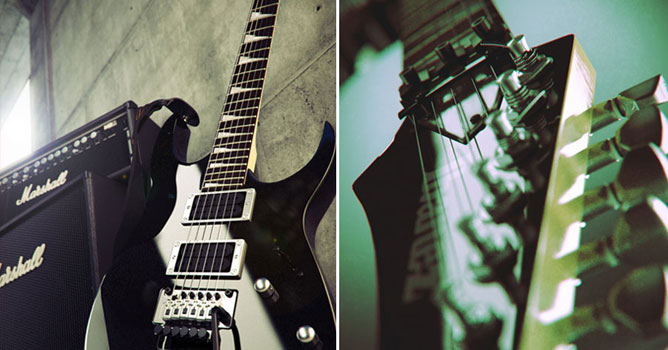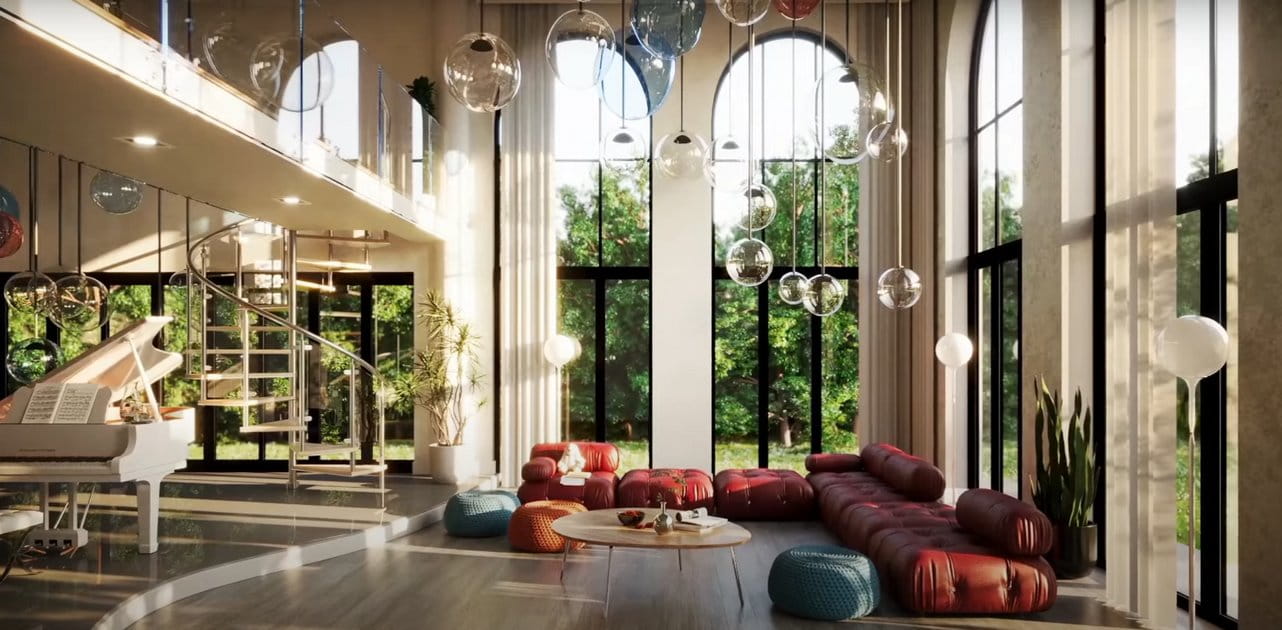
This is an old project started about year ago and finished recently. I spent almost all my free time during a year with interruption form half a year to one month. I hadn't any concept, only some vision in mind. It's not a good way to start project without certain conception, but I used to. So I made many unused textures models and etc., but actually I doesn't worry about wasted time - anyway it gave me some expirience.
MODELING
It was important to me to make very accurate model, even if not will be visible in final, so I wasn't surprised when it realy happened. At the same time I was sure - any position of cameras cannot uncover parts with too little details, cause I haven't such.
The fist thing I did is have take photos of my own guitar for using its as references and source for textures. Than I draw small sketches of all small details and marked all necessary measurements. The front view photo I took from Ibanez website, although its was not exact my guitar but enough alike. It was simpler then tring to take good, not distorted photo.
Of course it hasn't sense to talk about modeling process, even if it took most time. Modeling in Modo not to much differ from other similar software, but in my opinion it's faster and I just enjoy it.
MAPPING/TEXTURING
Mapping also didn't have any issues. Only some object have certain unwrap, other have simple box or planar mapping or haven't any mapping.
some of textures:
Some of used materials:
ENVIRONMENT
Actually it's not first variant of environment. Also I had 3 unsuccessful attempts. As I said, it's not a good way to start project without certain conception.
All light sources is simple plane object with MaxwellMaterial emitter. I used place highlight tool in max to make nice reflected light source on object in certain spot. I don't used skylight and sun because it not affect final lighting but it slowdown render. The part of the wall was subdivided for noise modifier, that affect very little so the wall wasn't too flat.
As you can see, the general image, (guitar with amplifier) don't make it possible to see all the details. So it was good idea to make additional renders, but in different environment - something like studio.
POSTPROCESSING
Most likely postprocessing was quickest and easier stage. I used only Curves for colorcorrection with settings like on image below. It makes green hue at all and some blue in shadows:
and also I used 'Filter>Distortion>Lens Correction' with set up Chromatic Abberation (+6 and -6) and Vignette. Postprocessing step by step:
Shirzad Bahrami's FEM-based muscle tool fills the gap left by Ziva VFX's cancellation, bringing realistic character deformation to multi-platform pipelines at 130ms per frame with 30-minute setup. Commercial subscriptions are now available with 10-day free evaluation.
The RTX 5090 launched at $1,999 MSRP with 32GB unified VRAM, while two RTX 5080s cost the same upfront but split 16GB per card. Performance scales differently per engine: OctaneRender favors dual 5080s by 13%, but Blender Cycles and VRAM-heavy exteriors favor the single 5090.
Maxon has launched separate Agentic Licenses for Cinema 4D ($49/month with Redshift) and Autograph ($29/month), plus a new Maxon Plus platform ($10/month) for AI-generated assets. Headless versions let studios run AI assistants on separate machines without consuming artist seats.
AMD's FSR 4.1.2 plugin for Unreal Engine extends machine learning upscaling to older Radeon discrete GPUs and mobile processors. DirectX 12 only; Vulkan support not yet available.
Autodesk's November 2026 release adds native 4D Gaussian Splat import with viewport rendering and an MCP Server that lets Claude and other AI tools modify scenes via natural language - two capabilities archviz artists are already adopting in production.
Autodesk Assistant, a new agentic AI tool, arrives in tech preview for Maya and 3ds Max subscriptions. Official MCP servers let external AI agents like Claude automate scene tasks with built-in approval controls.
NVIDIA's RTX Spark desktops from ASUS, Dell, and MSI bring Blackwell GPU and Grace CPU to compact form factors, offering 128GB unified memory and local AI inference. Entry points start under $4,500, though ROI versus render farms remains unquantified for archviz studios.
Unreal Engine 5.9 Preview ships November 9 with browser-based delivery and collaborative Canvas workspace, but memory limits and shortened QA mean preview builds suit design iteration, not final client handoff. The release was built in one week largely by AI agents.
The RTX 5090 launched at $1,999 MSRP with 32GB unified VRAM, while two RTX 5080s cost the same upfront but split 16GB per card. Performance scales differently per engine: OctaneRender favors dual 5080s by 13%, but Blender Cycles and VRAM-heavy exteriors favor the single 5090.
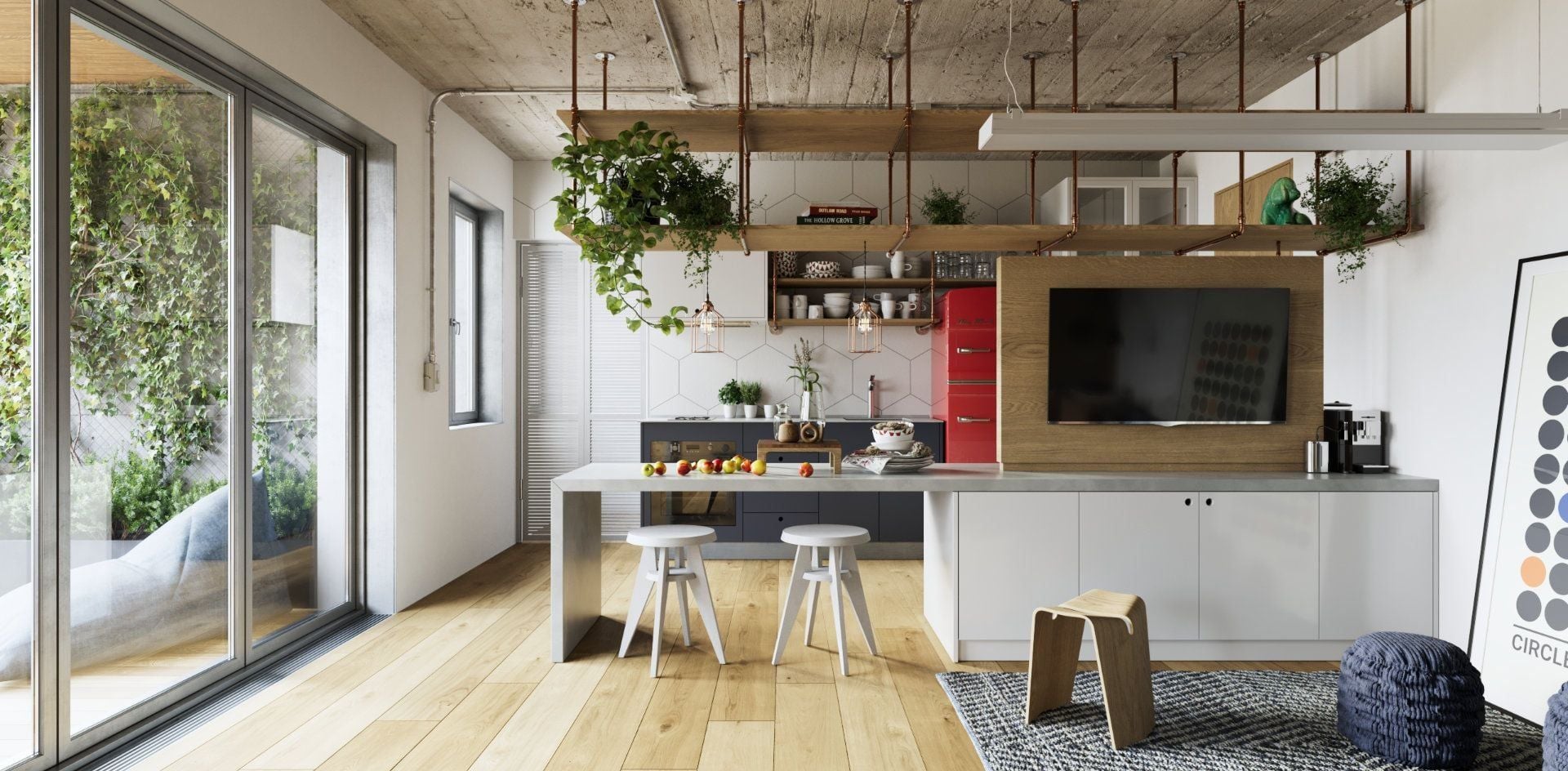
In this walkthrough, we guide you through the process of building a polished 3D interior scene inspired by the cover of Archmodels vol. 306 – Table Sets.
COMMENTS