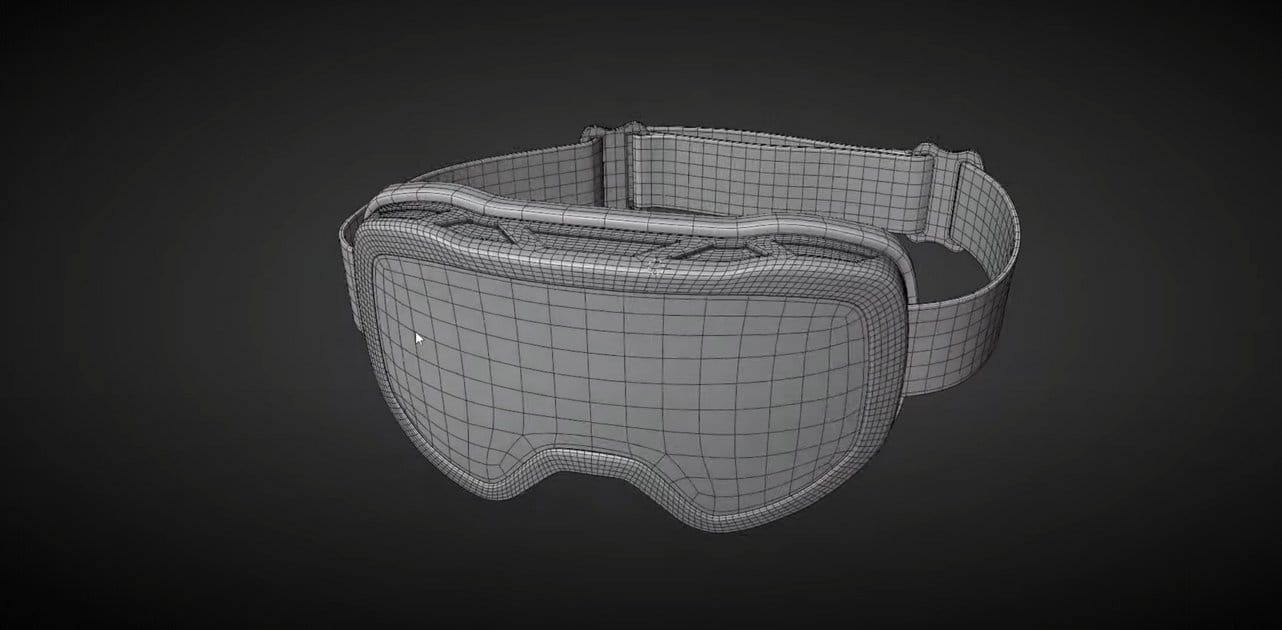
Using Blender modeling tools for creating realistic ski googles.
Modeling ski goggles in Blender, starting with a simple reference image or sketch, the process begins by creating a basic mesh that roughly matches the shape of the goggles' frame. Blender's set of modeling tools, such as extrusion, beveling, and subdivision, allows for precise shaping and detailing. The lenses are modeled separately with Siomple Bend and Empty object. Once the modeling and texturing are complete, adding final touches like straps, vents, and logos can enhance the realism and authenticity.
Good topology is fundamental in 3D modeling, playing a critical role in ensuring models are both efficient and visually appealing.
**Animation and Deformation**: Good topology ensures that a model deforms naturally and predictably during animation. Edge loops, particularly around joints (such as elbows and knees), allow for smooth bending and twisting. Properly placed vertices and edges help prevent issues like pinching and stretching, which can ruin the realism of an animated character or object.
**Subdivision and Smoothing**: Proper topology supports smooth subdivision, a technique used to increase the mesh's resolution while maintaining its shape. With good edge flow and quads (four-sided polygons), Blender’s subdivision surface modifier can create smooth, high-resolution models without introducing artifacts or irregularities.
**Texturing and UV Mapping**: Good topology aids in creating clean, efficient UV maps, which are essential for applying textures. Proper edge flow and face distribution ensure that UVs can be laid out with minimal distortion, making it easier to paint textures and apply detailed patterns without stretching or misalignment.
**Performance Optimization**: Efficient topology reduces the number of polygons required to achieve a detailed model, which is crucial for performance in real-time applications such as games and virtual reality. Lower polygon counts with well-distributed vertices reduce the computational load on rendering engines, improving frame rates and overall performance.
**Modeling Efficiency**: Working with good topology allows modelers to make changes and refine their models more efficiently. Clean edge loops and quads make it easier to add or remove detail, adjust proportions, and fix issues without creating complex, unmanageable geometry.
**Consistency and Standardization**: Maintaining good topology is a standard practice in professional workflows, ensuring that models can be easily shared, understood, and modified by different artists within a team. This consistency is crucial for collaborative projects and maintaining quality across a production pipeline.
In Blender, tools like the knife tool, loop cut, and slide, as well as modifiers like the mirror and subdivision surface modifiers, facilitate the creation and maintenance of good topology. By adhering to principles of good topology, modelers can produce high-quality, versatile models that meet the demands of both artistic vision and technical requirements.
Shirzad Bahrami's FEM-based muscle tool fills the gap left by Ziva VFX's cancellation, bringing realistic character deformation to multi-platform pipelines at 130ms per frame with 30-minute setup. Commercial subscriptions are now available with 10-day free evaluation.
The RTX 5090 launched at $1,999 MSRP with 32GB unified VRAM, while two RTX 5080s cost the same upfront but split 16GB per card. Performance scales differently per engine: OctaneRender favors dual 5080s by 13%, but Blender Cycles and VRAM-heavy exteriors favor the single 5090.
Maxon has launched separate Agentic Licenses for Cinema 4D ($49/month with Redshift) and Autograph ($29/month), plus a new Maxon Plus platform ($10/month) for AI-generated assets. Headless versions let studios run AI assistants on separate machines without consuming artist seats.
AMD's FSR 4.1.2 plugin for Unreal Engine extends machine learning upscaling to older Radeon discrete GPUs and mobile processors. DirectX 12 only; Vulkan support not yet available.
Autodesk's November 2026 release adds native 4D Gaussian Splat import with viewport rendering and an MCP Server that lets Claude and other AI tools modify scenes via natural language - two capabilities archviz artists are already adopting in production.
Autodesk Assistant, a new agentic AI tool, arrives in tech preview for Maya and 3ds Max subscriptions. Official MCP servers let external AI agents like Claude automate scene tasks with built-in approval controls.
NVIDIA's RTX Spark desktops from ASUS, Dell, and MSI bring Blackwell GPU and Grace CPU to compact form factors, offering 128GB unified memory and local AI inference. Entry points start under $4,500, though ROI versus render farms remains unquantified for archviz studios.
Unreal Engine 5.9 Preview ships November 9 with browser-based delivery and collaborative Canvas workspace, but memory limits and shortened QA mean preview builds suit design iteration, not final client handoff. The release was built in one week largely by AI agents.
Autodesk's November 2026 release adds native 4D Gaussian Splat import with viewport rendering and an MCP Server that lets Claude and other AI tools modify scenes via natural language - two capabilities archviz artists are already adopting in production.
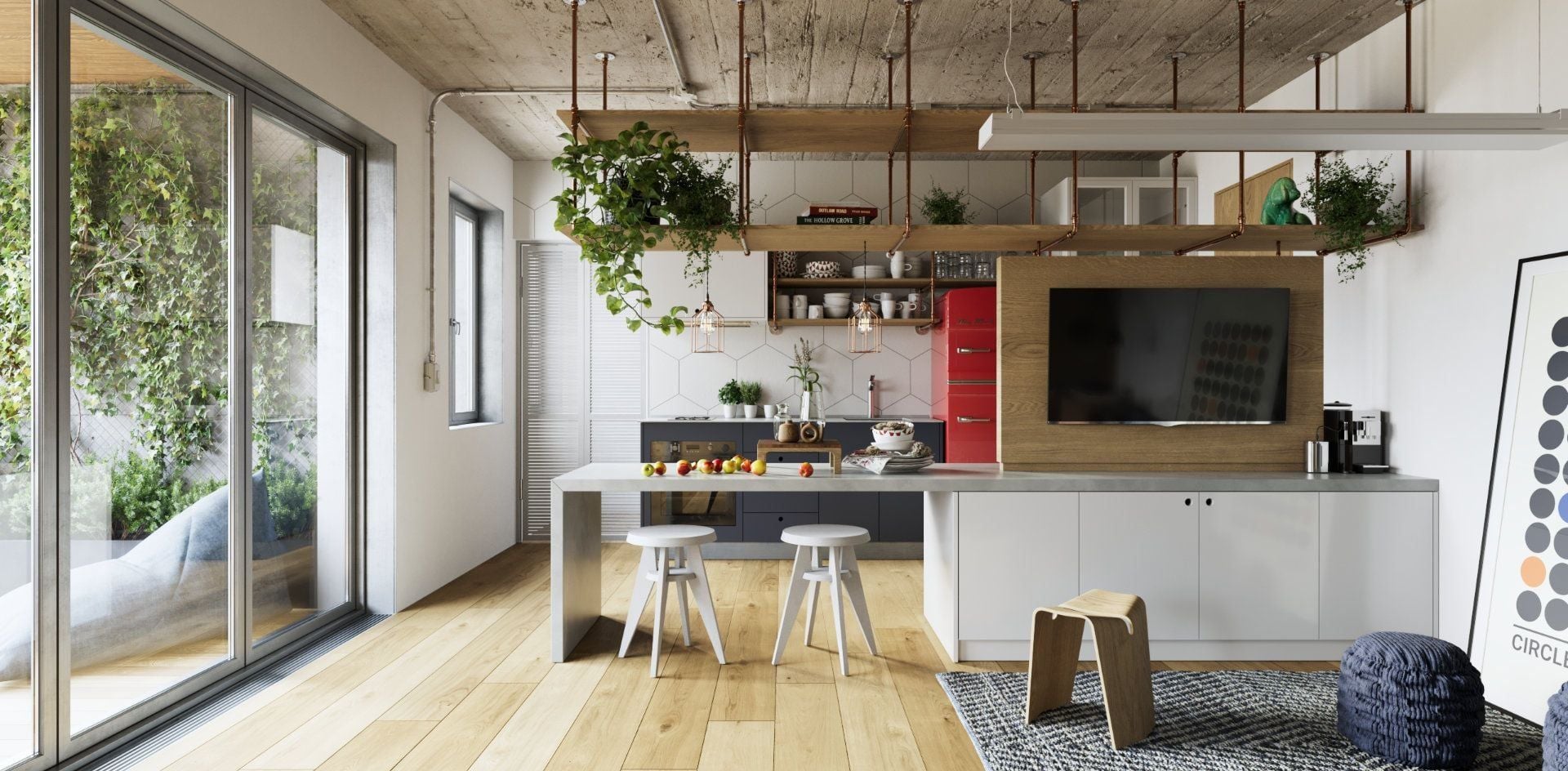
In this walkthrough, we guide you through the process of building a polished 3D interior scene inspired by the cover of Archmodels vol. 306 – Table Sets.














 Customer zone
 My courses
 Your orders
 Edit account
 Add project
 Liked projects
 View your artist profile

COMMENTS