New tools for modeling, workflow improvements and more.
15.0 introduces new workflow, like MeshFusion that has been re-envisioned from the ground-up to improve performance, refine user-experience and reduce technical barriers. MeshFusion has also received technology updates that further enhance this powerful toolset. Rig Clay, Command Regions and Form Presets have been updated to support meshops. QuickCam has also been added to mPath allowing for faster iteration.
New feature highlights:
MeshFusion has received a major revamp in Modo 15.0, with the UI being simplified and an emphasis being placed on a viewport-centric workflow for editing models. The inclusion of new selection modes such as Auto-Select, Source Select and Edit Attributes also now allows users to directly interact with their models, making it easier than ever to just click on a patch or source mesh to edit Surface Strips and Skirts.
Select source is a new mode in Modo 15.0, that allows you to select your source meshes in the viewport, instead of from the items list. Multiple source meshes can be selected and edited at the same time.
Edit Attribute is another new mode in Modo 15.0 that allows you to isolate and edit single strips, patches and corners, making detailed edits and detailing a much simpler task.
MeshFusion also now supports truly accurate Edge Weighting. When used in conjunction with MeshFusion's zero subdivision functionality, this allows for traditional cage-mesh boolean operations without subdivision surfaces while also allowing you to take full advantage of MeshFusion's powerful tools such as Fusion Strips and Patches.
The Chamfer Edit tool has been updated to allow the editing of rounded bevels. By ensuring that source segments are set to the same segment amount used, you are now able to change the offset, segment amount and curvature of a beveled edge with ease, making editing complex models a smoother and speedier process.
Modo 15.0 now allows you to enable cage mode by setting the subdivision level of a mesh to zero. This UX change cuts down on the amount of mouse clicks needed before a tool is ready to use and in turns allows your workflow to become more streamlined and efficient.
UnSubdivide is a brand new modeling tool in Modo 15.0 that allows you to reconstruct subdivisions in reverse and output a low density mesh. Perfect for creating low poly meshes for baking and optimization, this tool is available as a traditional tool in the modeling tool box, or as a procedural tool in the Mesh operation window.
Create Vertex MeshOp - This simple operator creates a single vertex and can be positioned in your scene by inputting coordinates in the X, Y and Z parameters.
Offset Curve by Mesh - Bezier, B-Spline and Polyline curves are now supported by the Offset Curve by Mesh operator.
Procedural Loop Slice - Loop Slice has now been added as a procedural tool, allowing you to create evenly spaced edge loops by a specific count number. Additional parameters such as Preserve Curvature and Split have also been included in the procedural version of this tool, to allow for in depth and advanced editing while using a procedural workflow.
The animation workspace this release has also had a major overhaul. The lower collapsible Graph Editor viewport layout has been replaced with a new layout that contains the Graph Editor and Dopesheet along with a Channels viewport, allowing for quick and easy navigation that is both beginner and seasoned professional friendly.
Veras 5.3 introduces NODES, a visual workflow builder now in Beta that lets users generate parametric geometry and bake it directly into Revit, Rhino, or SketchUp. The system shifts Veras from rendering-first to a full generative design platform with interactive design tools.
SketchUp 2025–2026 has added native PBR materials, AI image generation, and real-time rendering plugins like Lumion View, letting archviz artists produce photorealistic images without leaving the viewport. This collapses the traditional design-to-render pipeline.
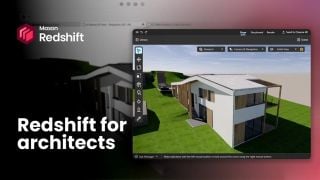
Maxon's Redshift 2027.0 cuts render times by up to 15% through memory optimization and adds official Archicad integration alongside improved materials and live feedback tools.
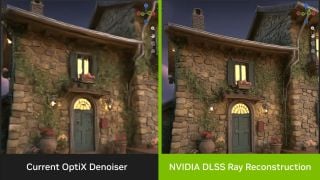
Blender 5.3 arrives November 10 with DLSS 4.5 Ray Reconstruction, an AI-powered denoiser for Cycles that works on RTX 20–50 series cards. The upgrade promises faster interactive lighting workflows at near-final quality.
Chaos released V-Ray for Blender 7.4 with Windows ARM64 compatibility, Phoenix Ocean textures for exterior scenes, Quick Sun Caustics for realistic lighting, and tools to organize large asset libraries and migrate from Blender's native renderer.
Maxon's October 2026 release adds procedural vegetation scattering, reworked GPU memory management in Redshift, and liquid simulation—streamlining environment work and viewport iteration for archviz studios.
A free community plugin now lets 3ds Max users with older GPUs access neural rendering via DLSS 5, potentially speeding up renders without hardware upgrades.
Chaos released V-Ray for Blender 7.4 with Windows ARM64 compatibility, Phoenix Ocean textures for exterior scenes, Quick Sun Caustics for realistic lighting, and tools to organize large asset libraries and migrate from Blender's native renderer.
In this walkthrough, we guide you through the process of building a polished 3D interior scene inspired by the cover of Archmodels vol. 306 – Table Sets.




 Customer zone
 Your orders
 Edit account
 Add project
 Liked projects
 View your artist profile












COMMENTS