How Evermotion became a full-scale production partner for archviz, automotive and synthetic data.
More Than an Asset Library
You probably know Evermotion from Archmodels, Archinteriors, Archexteriors. Over 18,000 ready-made 3D models built across two decades. That part hasn't changed.
What fewer people know is that commission work has been part of Evermotion for years. Custom environments, architectural visualizations, product renders - delivered on brief, on schedule. Recently, the scope has grown. Synthetic datasets, digital twins, product digitization, automotive environments - the range of industries and project types is wider than ever. And the infrastructure we built to keep 18,000 library assets consistent is exactly what makes these projects reliable at scale.
What We Work On
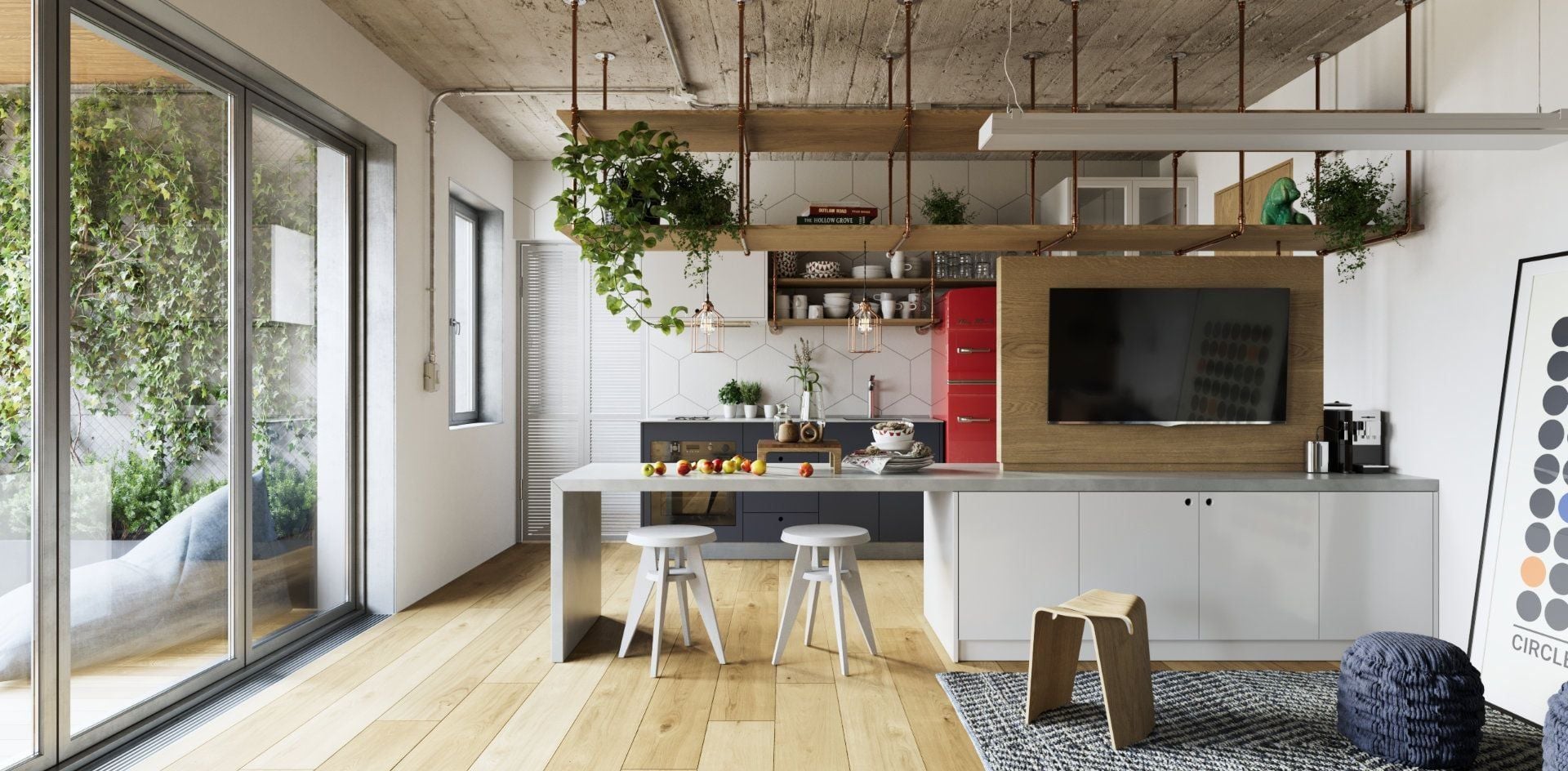
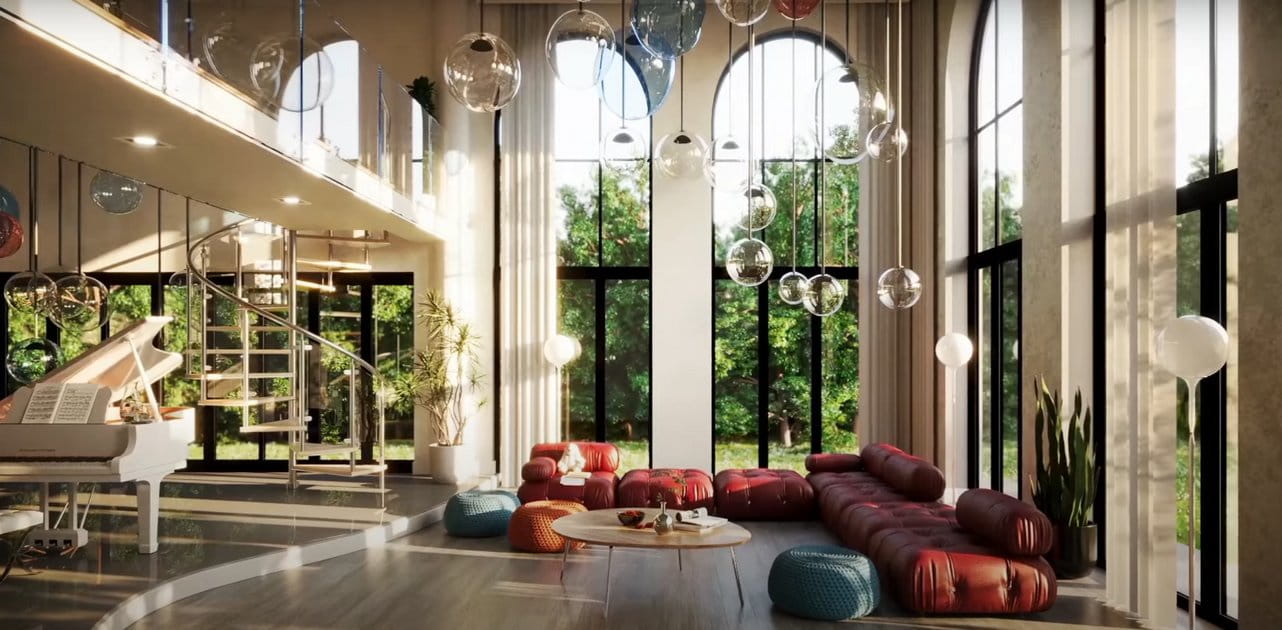
Architectural and interior visualization - residential, commercial, hospitality, public infrastructure, from small interiors to city districts.
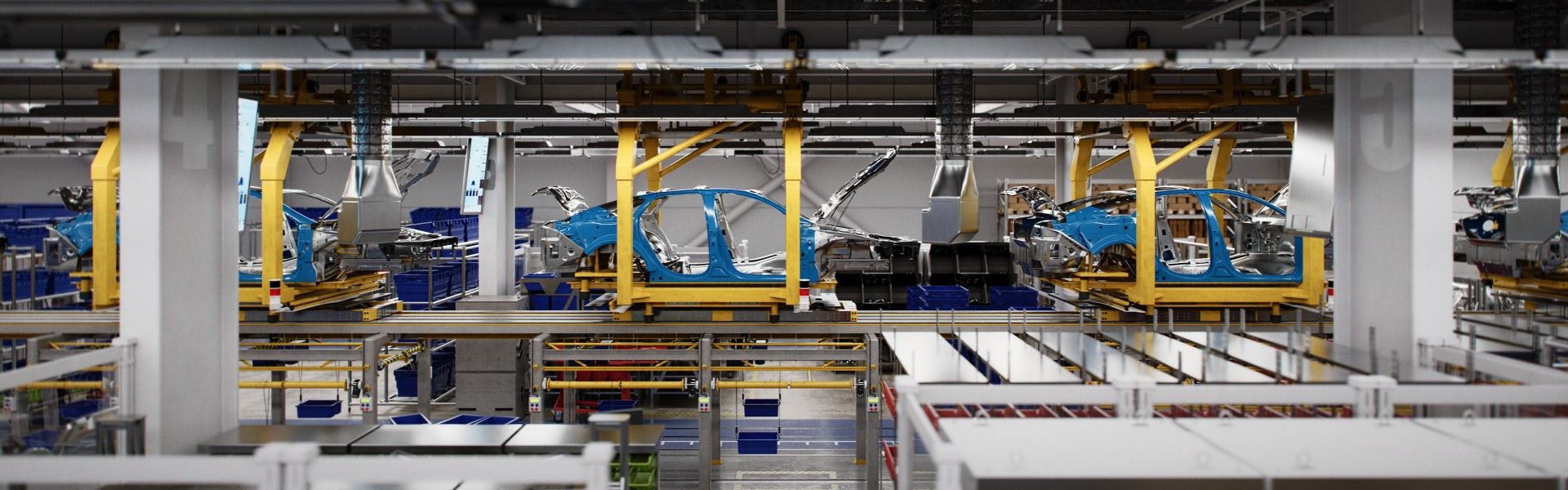
Automotive - product renders, configurators, environments for autonomous driving data.
Synthetic data for Computer Vision - training datasets with physical accuracy and cross-scene consistency.
Digital Twins and industrial simulation - real-world environments of each scale reproduced for simulation and planning.
Real-time and game engine assets - UE5, AR/VR, optimized without cutting visual quality.
Custom libraries and product digitization - dedicated collections of thousands of 3d models and 3D conversion of physical products.
Everything runs through a non-destructive pipeline. All content works across multiple DCCs.
Built on Physical Accuracy
We model from real-world sources - photographic documentation, photogrammetric scans, technical drawings, manufacturer specs. Proportions, scale and material behavior reflect the actual object, not an approximation.
On multi-scene projects this matters even more. Unified standards for modeling, lighting and texturing keep output consistent across dozens or hundreds of deliverables.
This discipline comes from the library itself. Thousands of assets that all had to work together in the same scenes forced us to treat accuracy as non-negotiable. A model with wrong proportions or inconsistent materials might look fine in a single still render - but it breaks an algorithm. That is why our synthetic data clients trust the same production foundation we use for archviz.
We build environments for fast-growing sectors - automotive, robotics, manufacturing, simulations. This goes beyond aesthetics. Our models feed machine learning pipelines that help companies automate processes and improve operational efficiency. Physical accuracy is not a nice-to-have here - it is the difference between a training dataset that works and one that teaches an algorithm the wrong things.
Working With Us
15 in-house artists. Capacity reallocated weekly. Timelines hold even when scope grows.
Every asset is verified for Unreal Engine and other real-time environments - topology, UVs, materials checked against defined standards before delivery.
Our artists read CAD documentation and understand technical requirements. The models they build are functionally correct, not just good-looking.
Weekly reports, progress previews, detailed change logs at every stage. Same team from brief to delivery - no rotating freelancers, no knowledge gaps between handoffs.
What Clients Ask Us
We’ve been collecting client questions for over 20 years. Here are the ten that come up most often.
1. How are your models made, and can they be used without legal concerns?
Every model is original work, built from scratch by our artists. We work from publicly available materials - product photos, catalogs, official specifications - and reconstruct proportions, shapes and materials with attention to detail. We do not copy files or data from anyone. Evermotion holds full copyright to all its products.
2. Are your environments full 360 degrees or only camera-locked?
They are complete three-dimensional scenes, not single-wall boxes. Older collections may have background areas optimized for specific camera angles - that was standard practice at the time. Newer collections are fully spatial. Place the camera anywhere, render from any angle. Check the product description and wireframe preview before purchasing, or contact us to pick the right scene.
3. What file formats do you support?
Core format is native 3ds Max - MAX files with materials for Corona Renderer and V-Ray. Depending on the product, we also offer FBX, OBJ, Cinema 4D, Blender and Unreal Engine formats. Each product page lists available formats. For larger orders or specific pipeline requirements, we can adapt - our non-destructive workflow and proprietary conversion tools make format flexibility practical, not just promised.
4. What kind of custom work do you take on?
We build complete 3D environments for architectural, interior, industrial and product visualization. We handle large projects with dozens of shots and complex scenes. We create marketing asset packages for developers. Beyond that: custom modeling, dedicated asset libraries for specific clients, product digitization (turning physical objects into production-ready 3D assets), digital twins, and datasets for Computer Vision and AI applications built to exact specifications.
We also work as extended capacity for other studios when deadlines are tight. Small studios and large corporations - both welcome. We typically respond within 48 hours.
5. Can I use the assets commercially and pass them on to clients?
Yes. Commercial use is the whole point.
Rendering for a client - **yes**, no restrictions.
Passing the source MAX file to a client - **no**.
Reselling or redistributing our assets - **no**.
You are buying a license for your studio's use, not redistribution rights. Full terms are in the EULA for each product. We offer multiple license types for different workflows and scales. If the standard license does not fit, contact us.
6. What is your stance on AI?
We see AI as a powerful tool that accelerates and automates processes in any company - ours included. Our asset library is entirely made and supervised by people. That has not changed.
Where we do use AI: building smart tools for automation, quality control, concept support, enriching the library with meta tags. These are practical applications that make the team faster without replacing what the team does.
We are confident that AI speeds up project delivery. But final quality and creative decisions still depend on a trained, experienced team working together. The tool is only as good as the people behind it.
7. What does Evermotion's production pipeline look like?
Every project - shop assets and custom commissions alike - goes through the same pipeline:
1. Modeling
2. UV mapping and unwrap
3. Texturing and materials (Corona Renderer, V-Ray, or project-specific)
4. Lighting setup
5. Rendering
6. Post-production
7. Quality Control
Quality Control is a separate stage, not a checkbox at the end. Every asset goes through a checklist: scale, materials, naming conventions, poly optimization.
8. What does working together on a project look like?
1. Brief - you send floor plans, visual references, technical requirements, deadline. The more detail upfront, the fewer revisions later.
2. Quote and schedule - you approve scope and timeline.
3. Production - early passes, revisions, final renders. You have visibility and feedback access throughout.
4. Delivery - files in agreed formats and resolutions.
9. Are the assets mine forever?
One-time purchases - yes, permanently. No renewals, no loss of access.
10. How does the subscription work?
A subscription gives you access to the asset library on a monthly or annual basis instead of paying per pack. It makes sense if you regularly need varied content across projects or your studio consumes a high volume of assets each month. If you know exactly what you need for one project, a single purchase is probably better.
Start with one month, track actual usage, decide from there.
Communication runs through email and a dedicated project manager. Larger projects get access to feedback management tools. Turnaround: small projects take days, complex industrial or development projects run to weeks - defined precisely at the quoting stage.
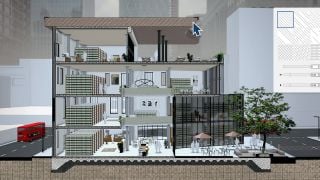
SketchUp 2027 integrates procedural modeling, AI rendering, and Claude-powered generation to speed concept work before handoff to external renderers. System requirements narrow to Windows 11 and Apple Silicon, and a Ruby upgrade may affect plugins.
ITOOSOFT's free ColorEdge plugin uses procedural edge detection to blend road and terrain materials without geometry or baking. It works with V-Ray and Corona CPU renderers on 3ds Max 2022–2026, though GPU users should test compatibility first.
Fumaris, a $39 GPU-based simulation extension for Blender 5.1+, lets archviz artists bake smoke and fire effects in real time using NVIDIA Flow, eliminating the traditional export-to-external-simulator workflow.
A new $39 plugin for 3ds Max 2022–2027 ports Maya's UV Editor interface—component modes, marking menus, and edge selection—directly into Max. Built on the native Unwrap UVW modifier with a 25% launch discount, it cuts repetitive UV work for archviz studios.
Substance 3D Painter 12.2 lets artists adjust baking cage distance per-pixel on the model itself, eliminating full-cage recalculations. New Order Independent Transparency also improves viewport preview of glass and transparent surfaces.
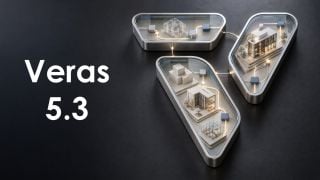
Veras 5.3 introduces NODES, a visual workflow builder now in Beta that lets users generate parametric geometry and bake it directly into Revit, Rhino, or SketchUp. The system shifts Veras from rendering-first to a full generative design platform with interactive design tools.
SketchUp 2025–2026 has added native PBR materials, AI image generation, and real-time rendering plugins like Lumion View, letting archviz artists produce photorealistic images without leaving the viewport. This collapses the traditional design-to-render pipeline.
Maxon's Redshift 2027.0 cuts render times by up to 15% through memory optimization and adds official Archicad integration alongside improved materials and live feedback tools.
A new $39 plugin for 3ds Max 2022–2027 ports Maya's UV Editor interface—component modes, marking menus, and edge selection—directly into Max. Built on the native Unwrap UVW modifier with a 25% launch discount, it cuts repetitive UV work for archviz studios.
In this walkthrough, we guide you through the process of building a polished 3D interior scene inspired by the cover of Archmodels vol. 306 – Table Sets.



 Customer zone
 Your orders
 Edit account
 Add project
 Liked projects
 View your artist profile









COMMENTS