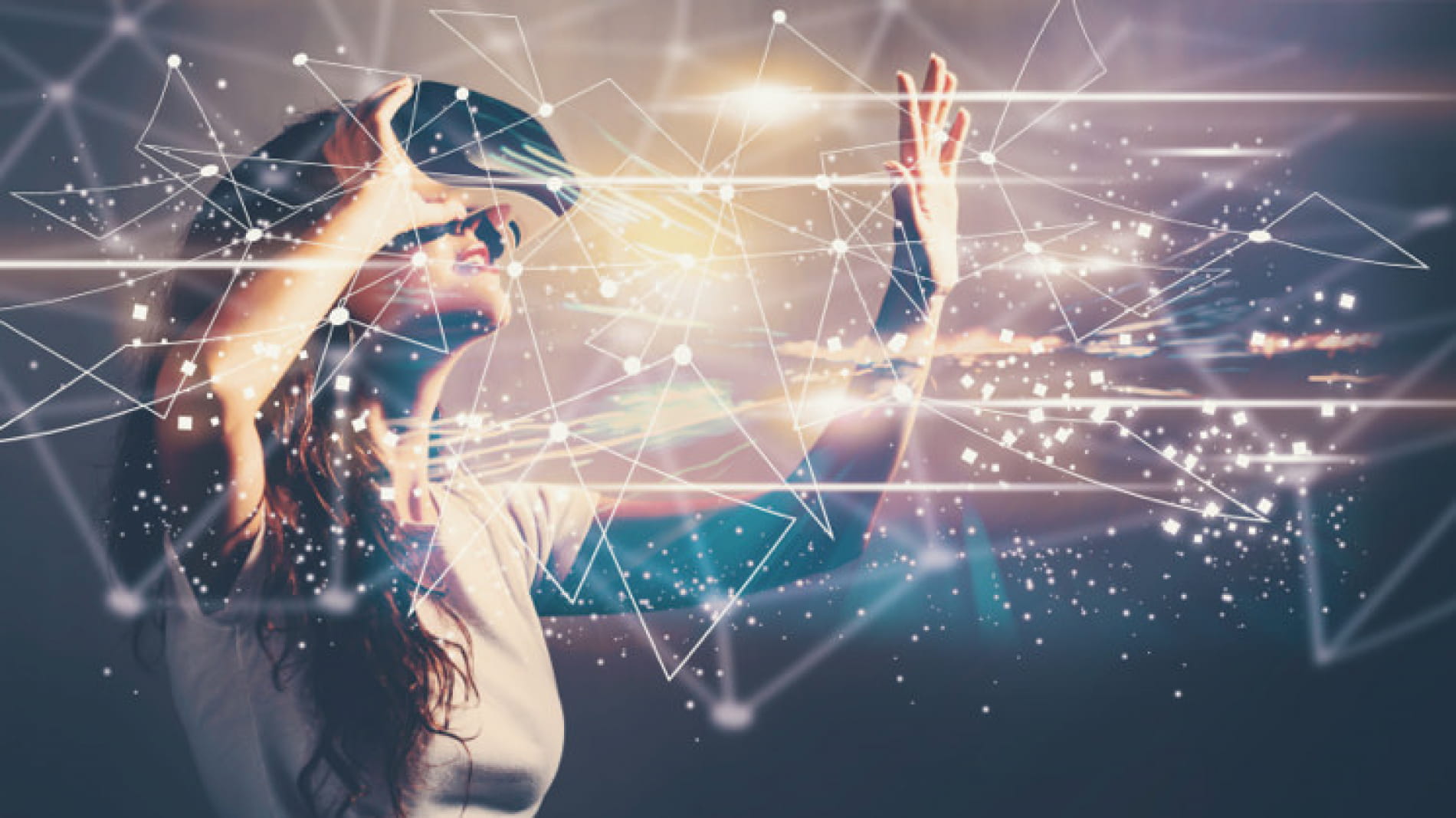
Virtual Reality: another world within sight
When we talk about Virtual Reality (VR), many of us think of science fiction films like 'Minority Report'. However, the truth is that nowadays, this technology completely blends in with our daily lives. Video games, medicine, education... Virtual Reality is here to stay. But what is it exactly?
239718
Virtual Reality creates simulated environments the user becomes immersed in by using specific headsets or helmets.
WHAT IS VIRTUAL REALITY?
Virtual Reality (VR) is a computer-generated environment with scenes and objects that appear to be real, making the user feel they are immersed in their surroundings. This environment is perceived through a device known as a Virtual Reality headset or helmet. VR allows us to immerse ourselves in video games as if we were one of the characters, learn how to perform heart surgery or improve the quality of sports training to maximise performance.
Although this may seem extremely futuristic, its origins are not as recent as we might think. In fact, many people consider that one of the first Virtual Reality devices was called Sensorama, a machine with a built-in seat that played 3D movies, gave off odours and generated vibrations to make the experience as vivid as possible. The invention dates back as far as the mid-1950s. Subsequent technological and software developments over the following years brought with them a progressive evolution both in devices and in interface design.
DIFFERENCES WITH AUGMENTED REALITY
Despite being a technology that originated decades ago, many people are still unfamiliar with the concept of Virtual Reality. It is also quite common to confuse the term Virtual Reality with augmented reality.
The main difference between the two is that VR builds the world in which we immerse ourselves through a specific headset. It is fully immersive and everything we see is part of an environment artificially constructed through images, sounds, etc. On the other hand, in augmented reality (AR), our own world becomes the framework within which objects, images or similar are placed. Everything we see is in a real environment and it may not be strictly necessary to wear a headset. The clearest and most mainstream example of this concept is Pokémon Go.
However, there is also a combination of both realities called mixed reality. This hybrid technology makes it possible, for example, to see virtual objects in the real world and build an experience in which the physical and the digital are practically indistinguishable.
MAIN APPLICATIONS OF VIRTUAL REALITY
That's enough about the theory that is projecting us into the future. Which sectors is Virtual Reality actually being used in today? Medicine, culture, education and architecture are some of the areas that have already taken advantage of this technology. From guided museum visits to the dissection of a muscle, VR allows us to cross boundaries that would otherwise be unimaginable.
Source:
https://www.iberdrola.com/
https://www.marafei.com/
Posted on 27.04.2022
You have to be logged in to like this project
 Nasser2022
LEAVE A COMMENT





 Customer zone
 Your orders
 Edit account
 Add project
 Liked projects
 View your artist profile