From the article, you will learn:
- How to approach a garden as a complete 3D environment
- How vertical and horizontal elements organize outdoor scenes
- How visual continuity improves scene readability
- How accents guide attention without visual overload
- How indoor and outdoor zones remain visually consistent
- How controlled detail supports professional CG workflows
Garden as a Structured 3D Environment
In CG production, a Garden is most effective when treated as a single, coherent environment. Instead of focusing on isolated elements, we work with spatial structure first. This approach enables the scene to function as a unified whole, with every part supporting overall readability.
Composition determines how space is interpreted. Clear organization helps the viewer understand distances, directions, and boundaries without confusion. Logical placement of elements reinforces spatial order and prevents visual chaos. Scale and proportion serve as coordinating factors, ensuring that all elements of the scene are aligned within a single visual system.
A structured garden scene supports the CG workflow by reducing guesswork later in the process. When spatial logic is established early, refinement becomes more predictable and controlled. The result is an outdoor environment that feels intentional and professionally constructed.
Trees and Vertical Balance in Outdoor Scenes
Vertical structure plays a defining role in outdoor visualization. Trees help establish visual hierarchy and organize space along the vertical axis. Their presence introduces height variation that naturally separates different spatial layers within the scene.
Vertical elements guide the viewer’s perception of depth. They help distinguish background from foreground without relying on excessive detail. This separation improves legibility and allows the eye to move through the scene in a controlled way. Height relationships also support accurate scale, which is essential in architectural visualization.
By carefully managing vertical balance, we maintain order without crowding the scene. The environment remains open and readable, with a clear structure that supports both wide views and closer perspectives.
Grass as a Tool for Visual Continuity
Horizontal continuity is just as important as vertical structure. Grass functions as a visual connector that unifies separate areas of an outdoor scene. It provides a consistent base that allows other elements to coexist within a shared spatial framework.
A continuous ground plane stabilizes the visual experience. It prevents abrupt transitions and supports smooth movement across the scene. When horizontal surfaces are treated consistently, the environment feels organized rather than fragmented.
This continuity is especially valuable in larger scenes, where multiple zones must remain visually connected. A stable horizontal layer enhances clarity and helps the viewer interpret the space as a single environment with internal variation, rather than a collection of unrelated areas.
Flowers as Accents That Guide Attention
Visual rhythm is built through controlled accents. Flowers serve as subtle focal points that guide attention across the scene. Their role is not to dominate, but to introduce variation that supports visual flow.
Smaller accents help break uniformity without disrupting balance. When placed thoughtfully, they create a rhythm that encourages the viewer to explore the scene gradually. This approach avoids visual overload while maintaining interest.
Contrast is used carefully to direct attention where it is needed. By limiting the number and intensity of accents, we maintain a calm tone and ensure the overall composition remains clear and professional.
Outdoor and Indoor Plants in Scene Cohesion
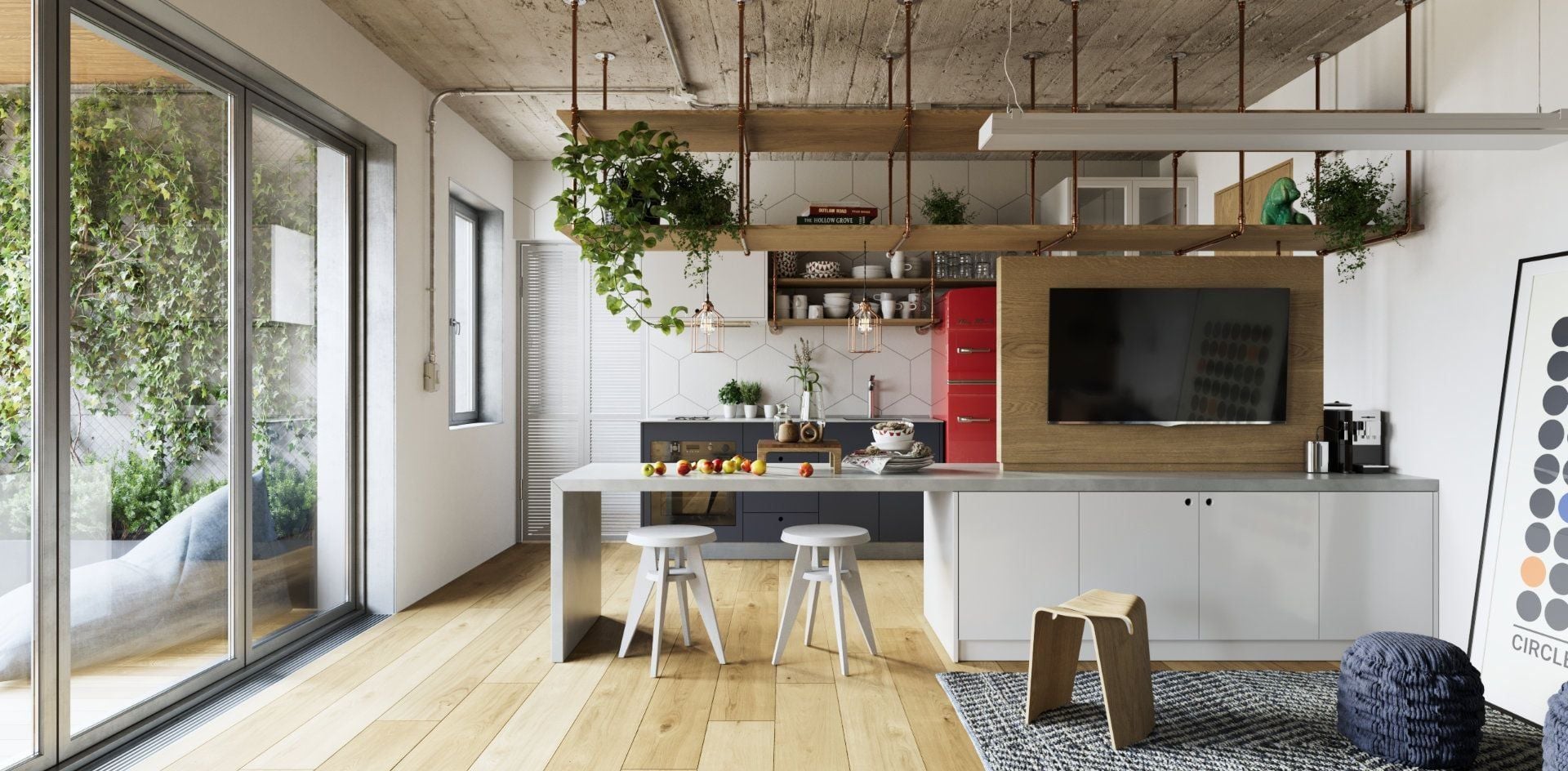
Architectural scenes often extend across interior and exterior spaces. Outdoor plants and Indoor plants help establish continuity between these zones when handled consistently.
Visual cohesion depends on a shared approach to scale, placement, and density. When exterior and interior environments follow the same visual logic, transitions feel natural rather than forced. This consistency strengthens the project's overall narrative.
Unified treatment of plant elements supports a seamless reading of space. The viewer experiences the project as a connected environment, not as separate scenes stitched together.
Controlled Detail for Readable Visualizations
Readable visualization relies on selective detail. Too much complexity can obscure structure, while too little can weaken spatial definition. Our focus is on balance = clarity achieved through deliberate choices.
Controlled detail helps maintain consistency across the scene. It ensures that no single area competes unnecessarily for attention. This approach allows composition and spatial relationships to remain the primary focus.
By managing details thoughtfully, we support a professional CG workflow and deliver environments that clearly communicate design intent. The final result is an outdoor scene that feels organized, coherent, and visually stable.
FAQ
How do 3D garden environments support architectural visualization?
A structured garden environment provides context and scale for architectural elements. It helps define spatial boundaries and guides the viewer’s perception without distracting from the main subject. Clear organization improves overall readability and supports consistent presentation across multiple views.
Why is spatial structure prioritized over asset quantity?
Visual clarity comes from relationships, not volume. A smaller number of well-organized elements communicates space more effectively than many uncoordinated ones. Structure allows the scene to remain readable and controlled, which is essential in professional visualization.
How do vertical elements affect scene perception?
Vertical elements organize depth and hierarchy. They separate visual layers and help establish scale. Proper height relationships help viewers interpret distance and orientation naturally, improving the overall spatial reading of the scene.
What makes horizontal continuity important in outdoor scenes?
Consistent horizontal surfaces connect different areas into a unified environment. They prevent fragmentation and help maintain visual flow. This continuity allows the viewer to move through the scene smoothly and understand it as a single space.
How can accents enhance a scene without causing overload?
Accents are most effective when used sparingly. Strategic placement guides attention and adds rhythm without overwhelming the composition. Limiting their presence preserves balance and keeps the scene calm and readable.
Why is cohesion between indoor and outdoor spaces necessary?
Architectural projects are experienced holistically. Visual consistency across interior and exterior areas strengthens realism and narrative clarity. When both zones share the same visual principles, the entire scene feels intentional and complete.
How does controlled detail improve professional CG results?
Controlled detail ensures that structure and composition remain clear. It prevents visual competition between elements and supports consistent quality across the scene. This approach results in cleaner visuals and more effective communication of design intent.






 Customer zone
 Your orders
 Edit account
 Add project
 Liked projects
 View your artist profile












COMMENTS