Search
Cart
Your cart - 0 items
Total: € 0
Total: € 0
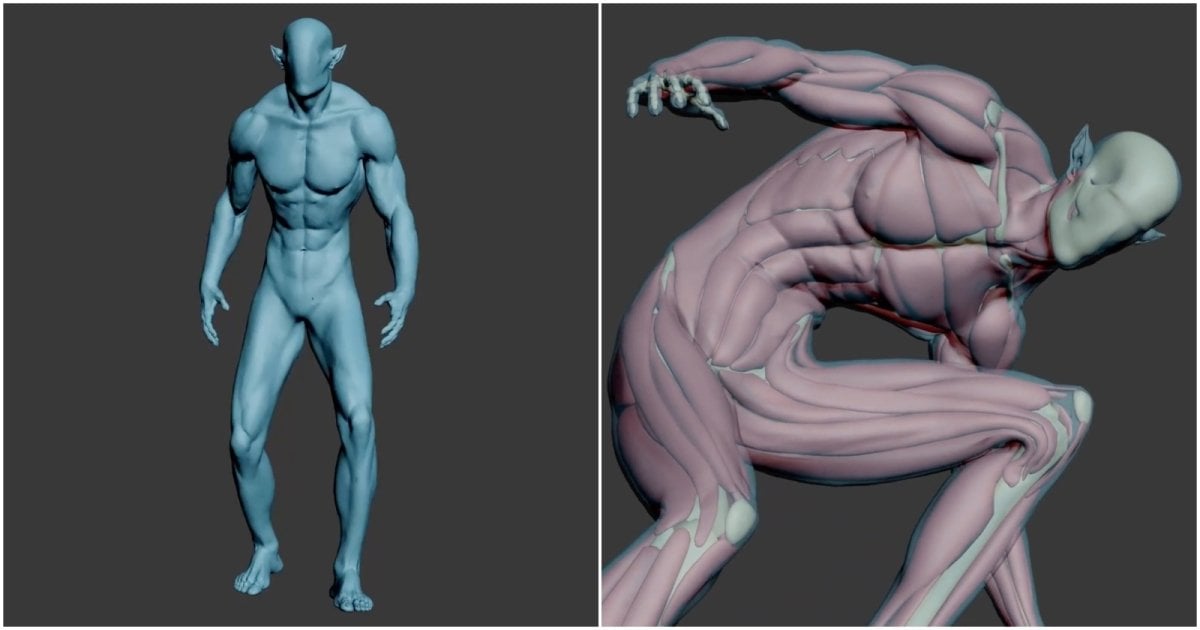

HézFX, a finite element method (FEM) based muscle simulation tool developed by Shirzad Bahrami (Senior Technical Animator at Activision Blizzard), is now available in commercial subscription tiers across 3ds Max, Maya, Blender, and Houdini on Windows. The release addresses the gap left when Unity cancelled Ziva VFX, the industry standard for physics-based character deformation.
The tool simulates muscle, fascia, fat, and skin as separate layers, each with its own material properties, solving them together in one pass. According to Bahrami, the approach prioritizes anatomical accuracy: "muscle contraction should travel along muscle fibres rather than activating uniformly across an entire muscle." For simpler characters, studios can omit layers they don't need - not every character requires all four tissue types.
Performance runs at approximately 130 milliseconds per frame including volume embedding, with typical setup taking around 30 minutes. While Bahrami notes that "as expected for FEM, it's not fast to simulate," the speed is production-viable for character-heavy visualization work.
The toolset includes density painting, proximity tools, automatic fiber direction detection, flex target shapes, and a profiler. Users can arrange a free 10-day evaluation that includes a one-to-one developer session. The software is still under active development, with standalone solving capability listed as a planned feature.
Video: 80 Level
For architectural visualization work incorporating complex hero characters or anatomically detailed human figures, HézFX offers realistic muscle deformation without leaving your primary 3D package. Studios that have relied on pose baking or simpler mesh deformation now have access to production-grade muscle simulation at the same quality level as VFX pipelines - and Blender users gain parity with Max and Maya workflows that previously had limited options.
The 30-minute setup time and per-frame cost fit within visualization schedules where characters are key to the story. For visualization houses building out character capability, this removes the need to adopt engine-specific tools or maintain separate simulation pipelines. If you're already comfortable with simulation in your host package - familiar with crowd systems in 3ds Max or cloth and physics workflows - HézFX extends that same in-package approach to character muscle behavior.
Lead image: 80 Level



LEAVE A COMMENT







|

|

|

|

|
 Customer zone
 My courses
 Your orders
 Edit account
 Add project
 Liked projects
 View your artist profile

COMMENTS