Search
Cart
Your cart - 0 items
Total: € 0
Total: € 0
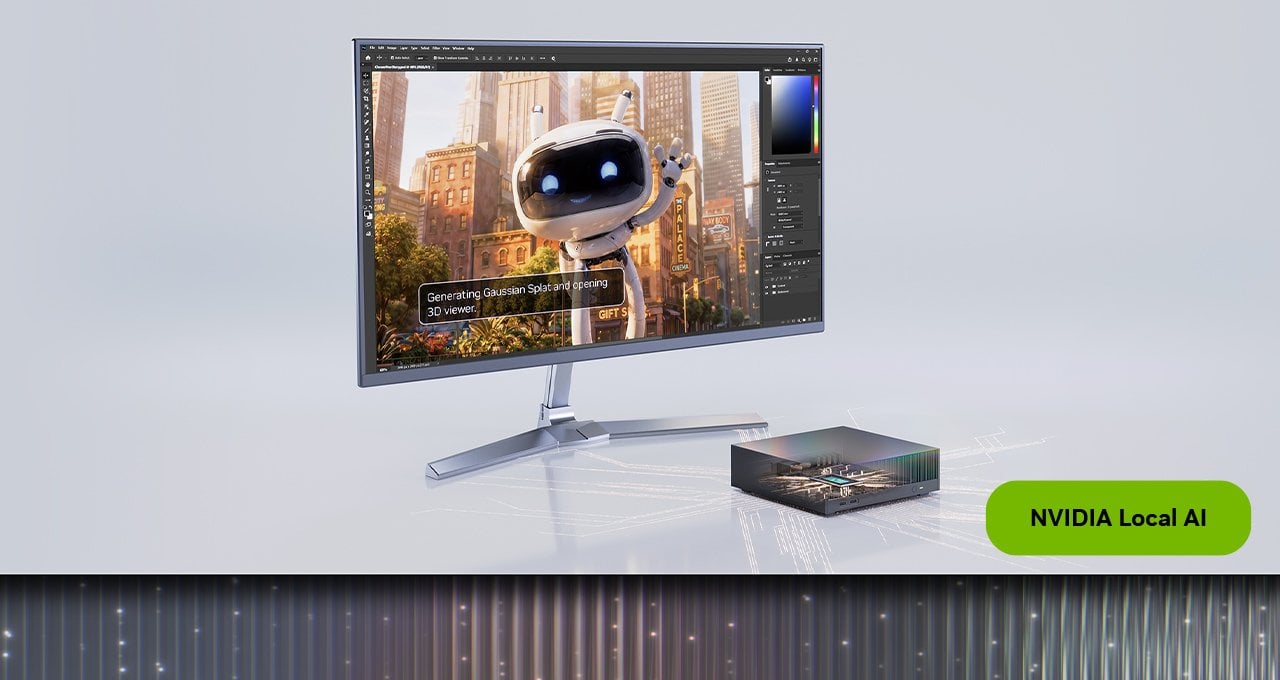

NVIDIA has released RTX Spark compact desktops from ASUS, Dell, and MSI as of November 18, 2026, targeting creators and developers who need local GPU compute for real-time 3D rendering and AI inference. Each system pairs a 20-core NVIDIA Grace CPU with a Blackwell RTX GPU delivering 6,144 CUDA cores and up to 128GB of unified memory on a single die.
The hardware can render 3D scenes exceeding 90GB in real time, edit 4:2:2 video smoothly, and run supported language models with as many as 120 billion parameters without cloud calls. NVIDIA's official announcement does not list pricing, but the MSI EdgeMesa N AI+ 64GB model was reported at $4,699 at launch and subsequently reduced to $4,399 within days. The 128GB configuration is expected to exceed $7,500. Additional compact systems from Acer, GIGABYTE, HP, and Microsoft Surface are expected to follow.
Adobe's creative suite gains acceleration through NVIDIA TensorRT-RTX. Premiere features including Enhance Speech, Object Mask, Scene Edit Detection, and Auto Reframe now run locally, with over 50 percent quicker turnaround on everyday H.264 video deliverables. Adobe Illustrator delivers up to 30 percent higher performance than its emulated version on RTX Spark hardware. Most relevant for archviz pipelines, Substance 3D Painter 12.2 is now optimized for RTX Spark with native support on Arm for the first time in public beta, removing emulation overhead for texture work.
An Adobe MAX 2026 demonstration showed a real-time sketch-to-animation workflow completing in under five minutes on local RTX Spark hardware. Sketch transformation took approximately 80 seconds, scene direction around 15 seconds, and video generation between 90 and 120 seconds - all without leaving the desktop or making cloud API calls.
For archviz studios, RTX Spark desktops lower the per-artist GPU compute barrier when render farm costs climb and RTX 5090 availability remains tight. The 128GB unified memory and native optimization support distributed V-Ray and Corona job processing without cloud dependency. Substance 3D Painter native Arm support removes the friction of emulation, improving texture iteration speed for small teams.
What remains unclear is whether sub-$5,000 on-premise hardware beats managed render services over a typical 3-year useful life. Independent performance benchmarks comparing RTX Spark desktops to traditional workstations or render farms at equivalent cost have not been published. Windows on Arm adoption for professional creative software beyond Adobe and Substance 3D Painter is also unverified. Local AI inference costs versus cloud API alternatives in real production scenarios have not been documented with case studies.
Before committing to RTX Spark hardware, studios should model the total cost of ownership: capital outlay, electricity, maintenance, and job turnaround time against their current render farm or cloud service contracts. The calculation will vary with job size, frequency, and in-house expertise.
Lead image: NVIDIA Official Blog


LEAVE A COMMENT






|

|

|

|

|
 Customer zone
 Your orders
 Edit account
 Add project
 Liked projects
 View your artist profile

COMMENTS