Search
Cart
Your cart - 0 items
Total: € 0
Total: € 0
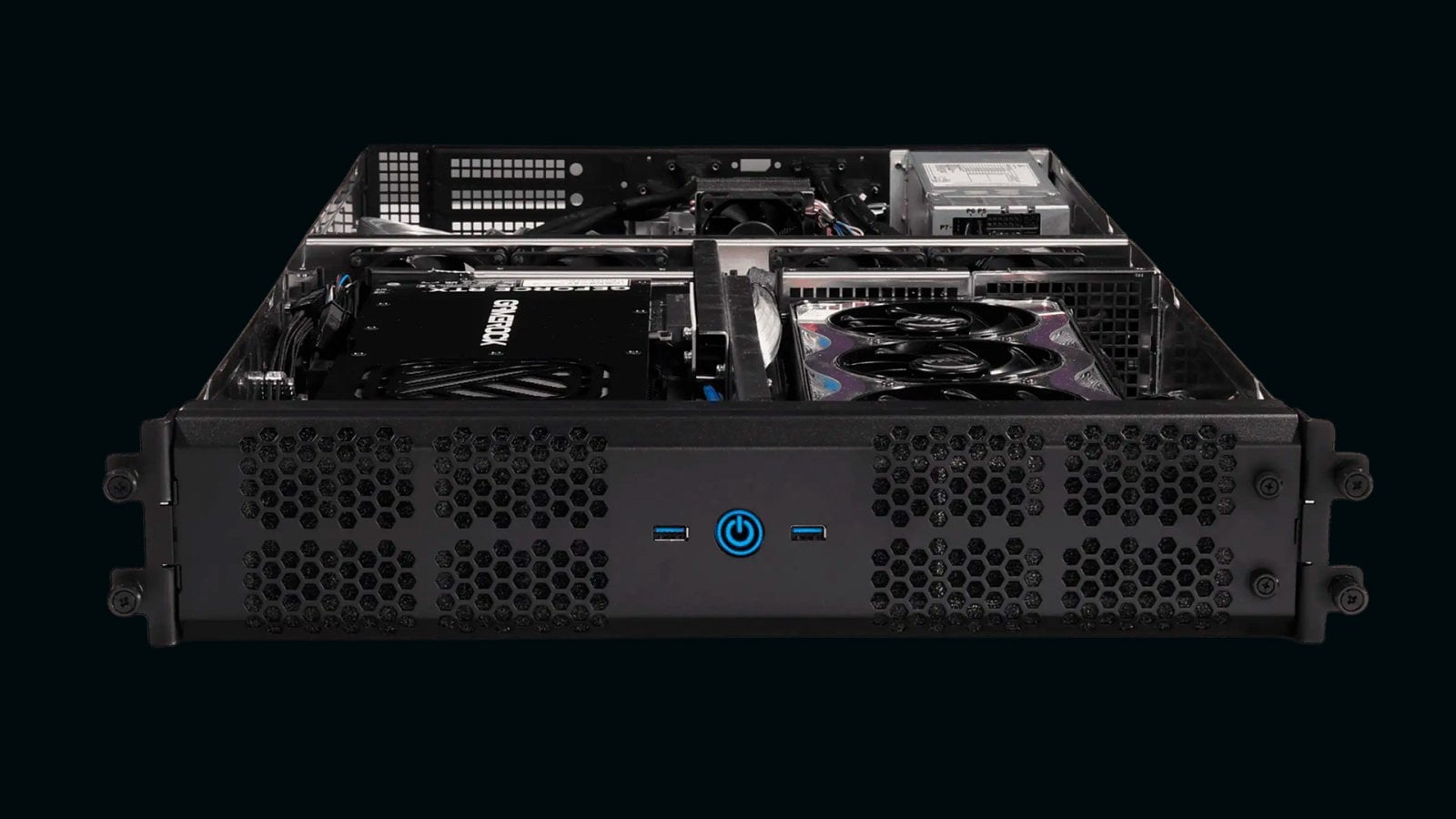

G2 Digital launched the 2U Q-Power on November 10, a compact GPU server designed to give archviz studios a local alternative to cloud rendering when discrete GPU costs remain elevated. The Hampshire-built system fits up to four NVIDIA GPUs into a 2U rack chassis by mounting cards horizontally, parallel to the motherboard, delivering what AEC Magazine calls "twice the capacity of most conventional 2U servers".
The platform ships in two configurations, each targeting different studio economics. The PT9W workstation pairs an AMD Threadripper CPU with two GeForce RTX 5090 GPUs. The SE5 server variant uses an AMD EPYC CPU and can hold up to four NVIDIA RTX PRO 4000, 5000, or 6000 cards. In its maximum form - quad RTX PRO 6000 Blackwell - the SE5 provides 384GB of aggregate GPU memory across all four cards.
V-Ray CUDA benchmark figures from G2 Digital show the performance gap: the dual RTX 5090 path scores 21,939 in their test, versus 9,242 for the quad RTX 4000 ADA configuration. That 2.4x difference reflects the raw speed advantage of consumer-grade RTX over professional RTX PRO silicon. Cinebench 2026 (GPU) scores tell a similar story: 300,936 for dual 5090 versus 230,466 for quad RTX 4000 ADA.
Both configurations include redundant 2.7kW power supplies, dual 10GbE NICs, and IPMI remote management. The physical footprint is tight: 430 x 887 x 88.8mm, weighing 18kg. That density is the system's central claim - fitting four GPUs into 2U without vertical stacking or external enclosures.
Video: G2 Digital
For archviz studios building or expanding render farms, the 2U Q-Power's dual-path design lets you model cost-per-frame on your own hardware rather than cloud consumption. The RTX 5090 configuration favours raw throughput; the RTX PRO route trades peak speed for memory headroom and lower per-frame cost on longer, memory-intensive scenes.
G2 Digital claims the system reduces cloud API spend meaningfully. Response latency can drop from around 1.5 seconds with cloud providers to less than 40 milliseconds running workloads locally. The company also claims up to 18x lower cost per million tokens than premium cloud AI APIs under sustained loads - a figure that depends heavily on your existing cloud spend and render volume.
On-premise economics matter most when you have steady render workloads: data stays in-house, avoiding GDPR or compliance friction with external services, and you avoid per-frame or per-token API charges that accumulate quickly across a production pipeline.
Critical unknowns remain. G2 Digital has not published pricing for either configuration, nor announced availability or shipping timelines. Peak power draw under rendering workloads is unspecified - the 2.7kW supply is specified for the hardware, but only AI inference power is documented. Most importantly, the V-Ray CUDA and Cinebench scores are G2 Digital's own benchmarks and lack independent validation from production studios. Windows Forum notes that the 384GB aggregate memory specification is distributed across four cards and that "performance claims need workload testing" before render farm budgets commit.
Archviz studios evaluating the 2U Q-Power should ask G2 Digital for real-world rendering results from production users, real peak power consumption data under V-Ray or Corona workloads, and cost-per-frame comparisons on your own scene complexity. Until third-party studios report results, the headline specifications tell only part of the story.
Lead image: AEC Magazine




LEAVE A COMMENT





|

|

|

|

|
 Customer zone
 Your orders
 Edit account
 Add project
 Liked projects
 View your artist profile

COMMENTS